top of page

Why Founder CEOs Need Enterprise Architecture

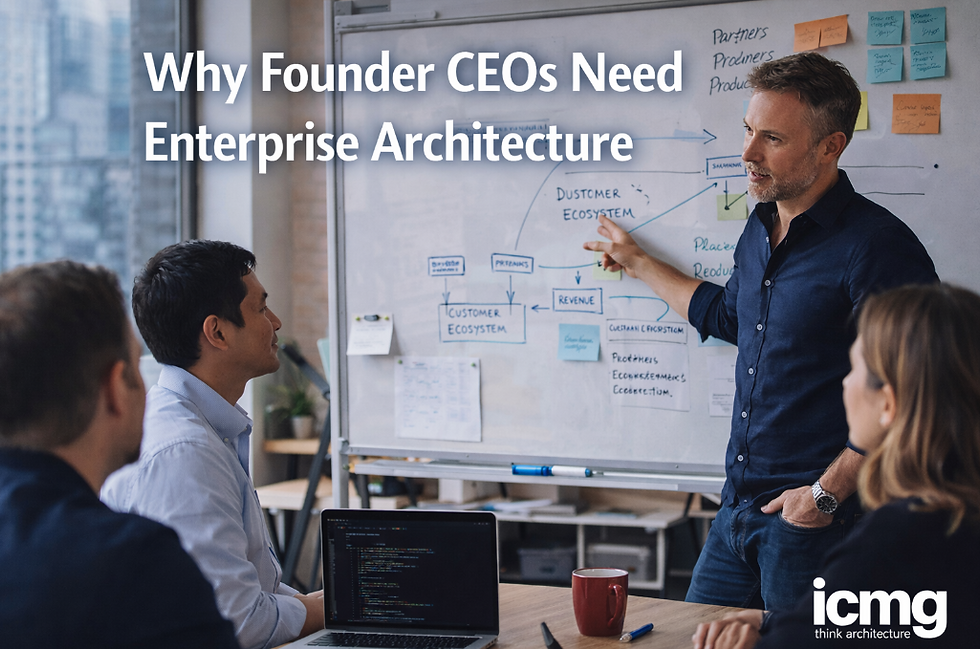
Founder CEOs are rarely short of vision, conviction, or speed.


They see the opportunity before others do. They move early. They make fast decisions. They hold the company together across product, customer, hiring, funding, delivery, and strategy. In the early stages, this is a strength. It creates momentum. It compresses decision time. It helps the company survive.


But as the enterprise grows, the same strength begins to create a hidden structural risk.

The company starts to run on the founder’s memory.


Not just the founder’s vision. The founder’s memory.


The memory of why a decision was made. Why a workaround was allowed. Why one customer was treated differently. Why one product path was prioritized. Why one exception became permanent.


At that point, the enterprise is no longer scaling on structure. It is scaling on founder-held memory.


That is exactly why founder CEOs need Enterprise Architecture.


Why the Founder’s Strength Becomes the Company’s Dependency

In founder-led enterprises, execution often appears highly aligned from the outside.


The founder knows the product. The founder knows the customer. The founder knows the trade-offs. The founder can settle disputes quickly. The founder can override ambiguity with instinct.


This works powerfully at small scale.


But as functions multiply, teams expand, products diversify, markets widen, and systems become more permanent, the enterprise begins to depend on the founder for something it should no longer require: structural coherence.


Questions that should already be answered by the enterprise itself keep coming back to the founder:

Why are two teams solving the same problem differently?

Why does one region sell differently from another?

Why does delivery depend on exceptions?

Why do customer issues return even after they were “resolved”?

Why do leaders keep escalating matters that should already be governable?

When this starts happening, the issue is not that the team is weak.


It is that the enterprise anatomy is still sitting inside the founder.


What Founder CEOs Often Misread

Most founder CEOs correctly sense that something is breaking as the company grows.


But the break is often misread. It is diagnosed as:

  1. a people problem

  2. a management bandwidth problem

  3. a communication problem

  4. a process maturity problem

  5. a leadership layering problem


Sometimes it is all of those at once. But underneath them sits a more fundamental issue, the enterprise has grown faster than its explicit anatomy.


The founder can still see how strategy connects to product, how product connects to operations, how sales promises affect delivery, how customer exceptions affect platform logic, and how hiring decisions affect execution quality.


But that view often remains inside the founder’s head, not inside the enterprise. That is why the company feels coherent near the founder and fragmented further away.


What Enterprise Architecture Actually Does for a Founder CEO

Enterprise Architecture is often misunderstood as documentation, governance overhead, or an IT-side exercise. For a founder CEO, it is none of those things.


It is the discipline that takes what is still held in the founder’s head and makes it explicit, shared, and governable across the enterprise.


It does not reduce entrepreneurial energy. It prevents entrepreneurial intent from dissolving as the company scales.


It makes visible:

  1. how strategy translates into execution

  2. where decision rules actually sit

  3. which operating assumptions are shared and which are local inventions

  4. where systems have encoded temporary exceptions as permanent structure

  5. where growth is adding capability and where it is adding contradiction


In simple terms, Enterprise Architecture helps the founder move the company from founder-carried coherence to enterprise-held coherence.


The Real Risk for Founder CEOs

The greatest risk for founder CEOs is not losing control. It is creating an enterprise that appears to grow, while remaining silently dependent on the founder for alignment.


That dependency shows up in familiar ways.

  1. The founder becomes the final integration layer.

  2. Cross-functional conflicts rise faster than revenue.

  3. Senior hires struggle because context is incomplete.

  4. Decision quality drops as distance from the founder increases.

  5. Execution slows even when headcount increases.

  6. Leadership transitions become destabilizing.


At that stage, the company may still look energetic. But structurally, it is fragile. This is why many founder-led companies hit an invisible wall. Not because the founder has failed.Not because the market disappeared. But because the anatomy of the enterprise was never made explicit enough to survive growth.


Why This Matters More in Product and Platform Businesses

The issue becomes even sharper in product, platform, and multi-function enterprises.

Because once customer commitments, rule logic, product behavior, service models, pricing structures, risk decisions, and operational exceptions start interacting at scale, memory is no longer enough.


The founder may still understand the whole. But the organization increasingly operates in fragments.


Sales optimizes for conversion. Product optimizes for release. Operations optimize for continuity. Finance optimizes for control. Technology optimizes for systems. Each area acts rationally within its own boundary.


But enterprise outcomes are horizontal. They depend on shared anatomy across boundaries. Without that anatomy, the founder ends up doing what the enterprise itself should already be able to do: hold the whole together.


What Changes When the Founder Installs Enterprise Anatomy

When Enterprise Architecture is established properly, the founder does not become less important. The founder becomes less required as the daily carrier of structural coherence.


That is a major difference.


Strategy stops leaking as it moves through the company. Decision rules become explicit instead of founder-interpreted. Teams align through shared structure, not repeated intervention. Systems reflect enterprise logic more consistently. Leaders can own outcomes without constantly returning to the founder for hidden context.


Most importantly, the company becomes more durable than the founder’s immediate presence. That is the real scaling moment. Not when the org chart grows. Not when funding arrives. Not when the company expands internationally. But when the enterprise can hold its own anatomy explicitly.


The Founder’s Real Choice

At growth stage, every founder CEO faces a structural choice. The company can continue to run on founder memory, founder judgment, and founder escalation — working only as long as the founder remains the living control system.


Or the founder can make the enterprise’s anatomy explicit, so growth stops increasing fragility. That is why founder CEOs need Enterprise Architecture.


Not as process overhead. Not as documentation. Not as a late-stage corporate layer.

But as the discipline that allows a founder-built company to become an enterprise without losing coherence.

Enterprise Intelligence

Transforming Strategy into Execution with Precision and Real Intelligence

bottom of page