top of page

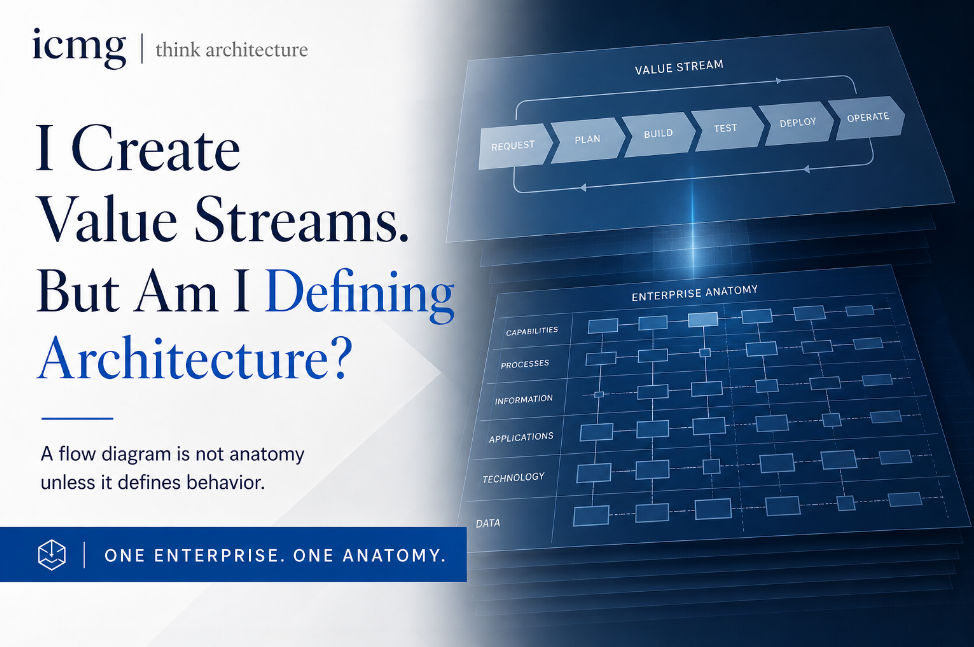
I Create Value Streams. But Am I Defining Architecture?

The Illusion of Flow

I create value streams.


Lead to order. Order to cash. Procure to pay. Issue to resolution. Concept to launch. Hire to retire. Demand to fulfilment.


The diagrams look clean.


They show stages. They show handoffs. They show departments. They show customer movement. They show where value appears to flow.


This is useful work. But useful work is not the same as architecture.


What a Value Stream Really Shows

A value stream usually shows how work moves from one state to another. It may show how a customer becomes a lead. How a lead becomes an opportunity. How an opportunity becomes an order. How an order becomes fulfilment. How fulfilment becomes billing. How billing becomes support.


It gives visibility into movement. But visibility is not architecture.


Because the real question is not only- How does value appear to move?

The real question is: What must be defined so that value is actually created, protected, measured, and delivered consistently?


That is where most value streams become weak.


The Missing P1 (Strategy) Link

A value stream often sits in the middle. It shows activity.

But it does not always link clearly to P1: Strategy — the direction and value outcomes the project must achieve.


If the value stream is lead-to-order, what is the strategic outcome?

Higher conversion? Lower sales cycle time? Better margin discipline? Lower discount leakage? Higher customer retention? Lower fulfilment rework? Better compliance? Faster revenue recognition?


Without this P1 link, the value stream shows movement but not purpose. It tells us what happens. But it does not tell us what must improve.


The Missing P3 (System) Link

A value stream also often fails to define P3: Systems / Logic.


P3 is where the real execution logic sits.

What rules decide whether a lead is qualified?

What data confirms customer readiness?

What logic decides pricing eligibility?

What function checks margin approval?

What event triggers contract review?

What UI action captures the decision?

What timing logic moves the case forward?

What exception logic handles non-standard commitments?


If this is not defined, the value stream remains a business flow. It does not become executable logic.


The phrase “qualify customer” looks simple on a diagram. But inside the enterprise, that phrase may require rules, data, systems, approvals, timing, exceptions, integrations, and audit logic.


If those are not defined, the value stream is only describing the surface of the flow.


The Missing P4 Link

A value stream also has to map into P4: Component Specifications.


P4 defines the parts required to make the logic real.

Data components. Rule components. Event components. Workflow components. UI components. Integration components. Reporting components. Audit components. Exception components.


Without P4, implementation teams are left to interpret the diagram.


One team creates fields. Another creates rules. Another creates workflow. Another creates integration. Another creates reports.


Each team may be correct locally. But the value stream still may not behave consistently. Because the components were never defined as one connected anatomy.


Customer Onboarding Example

Take a customer onboarding value stream.

Lead captured. Customer qualified. Account created. Documents collected. Contract approved. Service activated. Billing started. Support enabled.


The value stream looks complete. But is it architecture?


Only if it answers the deeper questions.

  1. What exact outcome must onboarding achieve? Is the goal faster activation, lower drop-off, better compliance, fewer errors, lower cost, better margin, or improved customer experience?

    That is P1 (strategy).

  2. What exact decision sequence must occur from lead capture to support readiness?

    That is P2 (process flow).

  3. What rules decide qualification? What data confirms identity? What logic checks contract status? What timing event triggers billing? What exception logic handles missing documents? What system interaction moves the customer from sales to delivery to support?

    That is P3 (sub systems).

  4. What fields, rules, events, APIs, screens, workflow components, approval components, billing components, and support handoff components must exist?

    That is P4 (components).

If these are not defined, the value stream is not architecture. It is a middle-layer diagram.

What Happens in Execution

The value stream is approved. The workshop is complete. The diagram is published.

Everyone feels aligned. Then implementation begins.

Sales interprets qualification one way. Finance interprets pricing control another way. Operations interprets activation readiness differently. Support receives incomplete customer context. Technology builds based on partial assumptions.


The diagram looked aligned. Execution fragments. Not because the value stream was useless.


Because the value stream was not connected to the anatomy required to execute it.


Financial Impact

This becomes expensive.

Clarification increases. Rework increases. Change requests increase. Testing expands. Exceptions multiply. Manual workarounds continue.


The enterprise spends more on workshops, business analysis, configuration, integration, testing, governance, and correction.


But value is delayed. Revenue impact is delayed. Cost reduction is delayed. Customer experience improvement is delayed. Margin improvement is delayed.


The value stream promised movement. But execution absorbed the value.


Why the Term Becomes Dangerous

The problem is not that I create value streams. The problem is that the organization believes architecture is covered because the value stream exists.


So no one forces the hard questions.

What strategic outcome does this value stream serve?

What decision sequence does it define?

What logic makes each step executable?

What components must exist before implementation begins?


Without these answers, the value stream creates confidence before it creates clarity.

That is the danger.


The Real Correction

A value stream becomes architectural only when it connects:

P1 above — the strategic outcome and value target.

P2 within — the sequence of decisions and activities.

P3 below — the system and sub-system logic that executes the flow.

P4 below — the components required to make the logic real.


Without this connection, the value stream is useful. But it is not architecture.


Diagnostic Note

I create value streams. That is real work. That is useful work. That is important work.


But if the value stream does not link to P1 above and P3–P4 below, I am not defining architecture. I am drawing how value appears to move.


And calling that architecture is how projects look aligned on paper, but fragment during execution.


One Enterprise. One Anatomy.

Comments


Enterprise Intelligence

Transforming Strategy into Execution with Precision and Real Intelligence

bottom of page