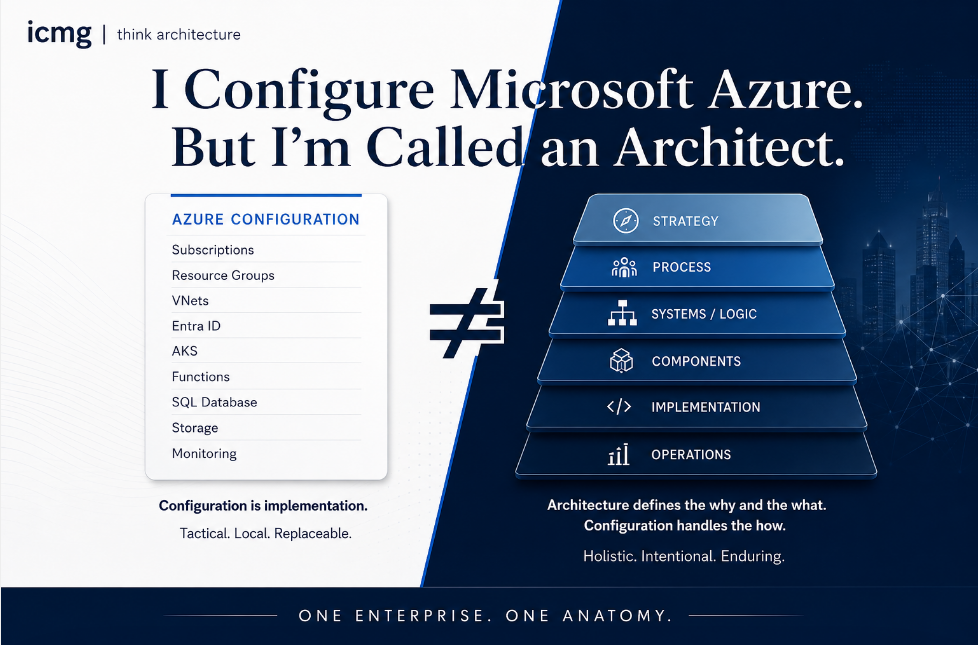
I Configure Microsoft Azure. But I’m Called an Architect.
- Sunil Dutt Jha

- 20 hours ago
- 5 min read

What I Actually Do
I configure Microsoft Azure.
I configure subscriptions. I configure resource groups. I configure virtual networks. I configure subnets. I configure network security groups.
I configure Azure Active Directory / Entra ID. I configure roles and access. I configure App Services. I configure Azure Functions. I configure AKS. I configure SQL Database. I configure Storage Accounts.
I configure API Management. I configure Application Gateway. I configure Key Vault. I configure monitoring, logging, backup, scaling, and deployment pipelines.
I define environments. I configure access policies. I create landing zones. I design network zones. I select managed services. I create infrastructure templates. I coordinate with developers, DevOps teams, security teams, database teams, testing teams, and operations teams.
This is important work. But important work is not the same as architecture.
What My Work Really Is
My work is cloud configuration and infrastructure implementation. It shapes how Azure is set up. It shapes how systems are hosted, deployed, secured, scaled, monitored, and operated.
But cloud configuration is still implementation.
It is not the same as defining what the project must achieve, how decisions must flow, how system and sub-system logic must behave across rules, functions, data, UI, access, timing, and interactions, and what components must exist before cloud configuration begins.
So when I configure Microsoft Azure and call that architecture, I am stretching the word beyond what I am actually doing.
The Civil Construction Equivalent
This is like working on a 50-storey building and configuring construction utilities, power distribution, access control, elevators, HVAC zones, fire alarms, backup systems, and monitoring panels.
All of this matters.
But no one would say the person configuring building utilities is the architect of the building.
The architect defines what the building is meant to be, how floors are organized, how people move, how functions are distributed, how load flows, how safety works, and how the building behaves as one whole.
Azure configuration is like deciding the construction and utility environment. It does not define the building. That is the same distinction here.
The Azure Project Distortion
In many cloud projects, this distinction disappears. Because Azure is powerful, flexible, and enterprise-grade, the person configuring Azure starts to feel like the architect.
And the organization reinforces that feeling.
If I design subscriptions, landing zones, virtual networks, AKS, App Services, SQL Database, Key Vault, API Management, CI/CD, observability, and security controls, it looks like I am architecting the system.
If I understand cloud patterns, identity, access, availability zones, failover, encryption, scalability, cost management, and deployment automation, it looks like I am defining structure.
But what I am actually doing is configuring how the system will be hosted, deployed, secured, and operated.
That is not the same as defining the project anatomy.
What Is Usually Missing
Before Azure configuration begins, P1–P4 of the same project should already be explicit.
P1 is Strategy: the direction and value outcomes the project must achieve.
P2 is Process: the sequence of activities required to realize the strategy.
P3 is Systems / Logic: the systems and sub-system logic that execute or enforce the business flow — including data logic, rule logic, function logic, access logic, UI logic, timing logic, and interaction logic.
P4 is Component Specifications: the parts that make those systems real — data, functions, rules, events, interfaces, UI, network, and other component specifications.
In many Azure projects, this does not happen clearly. So cloud configuration starts filling the gap.
The infrastructure becomes the place where the project is “figured out”. That is where the distortion begins.
A Bank Lending Example
Take a bank lending platform being built on Microsoft Azure.
I configure API Management. I configure Azure Functions. I configure Azure SQL Database. I configure Blob Storage.
I configure Entra ID. I configure AKS or App Services.
I configure virtual networks, subnets, security groups, monitoring, logging, and deployment pipelines.
The platform looks modern. It is cloud-native. It is scalable. It is secure. It is automated. It is deployable.
But the real questions are different.
What exact lending outcome must this project achieve?
How should a loan application move from intake to eligibility, risk scoring, pricing, approval, documentation, disbursement, servicing, and collections?
How should eligibility logic interact with risk scoring?
How should risk scoring affect pricing?
How should policy exceptions affect approval?
How should documentation status control disbursement?
How should regulatory traceability be enforced?
If these are not explicitly defined first, then Azure configuration becomes an implementation of partial understanding. The cloud platform may work. The lending decision flow may still not work.
What Happens Then
The API works. The function runs. The database stores records. The container deploys. The logs appear. The monitoring dashboard is green.
But the lending decision still behaves inconsistently. Eligibility behaves differently across channels. Risk scoring qualifies a borrower, but pricing gives the wrong offer. Approval logic does not handle policy exceptions properly. Disbursement waits because documentation conditions were never explicitly connected. Collections logic does not reflect the original risk and pricing assumptions.
Every Azure component may work. But the project still behaves inconsistently. Because cloud configuration can only host and execute what has been defined.
If the project anatomy is not explicit, Azure only scales the gap.
Financial Impact
This becomes expensive. Every change requires rediscovery.
A change in lending logic affects APIs, functions, databases, containers, permissions, event flows, logs, reports, and integrations.
Impact analysis depends on experienced people because the underlying logic is not explicit.
Testing expands because many cloud components carry local assumptions.
Rework increases because downstream effects are discovered late.
Cloud spend increases because teams add more services, more environments, more monitoring, more integrations, and more automation to manage complexity.
The enterprise spends more on Azure engineers, DevOps teams, security reviews, testing, support, and stabilization.
At the same time, revenue is affected because approvals are delayed, offers are inconsistent, and customer conversion slows.
Margins are affected because rework, manual correction, cloud spend, support effort, and exception handling absorb value.
The platform becomes more expensive without becoming more precise.
Why the Title Becomes Dangerous
The problem is not that I configure Microsoft Azure. The problem is that the organization believes architecture is covered because I configure Azure.
So the harder work never gets done. No one stops and asks:
What exactly is the intended outcome?
What is the decision sequence?
What is the governing logic?
What are the required components before cloud configuration begins?
Instead, the project keeps moving because “the architect” is configuring the cloud.
That is how cloud configuration gets mistaken for architecture.
What the Role Really Is
A person configuring Microsoft Azure is a valuable cloud implementation specialist. He may be highly experienced.He may understand the platform deeply.He may coordinate large programs.He may know networking, identity, security, compute, storage, databases, containers, serverless, monitoring, cost control, and operations.
That still does not make the role automatically architectural. It makes the role essential within implementation.
But architecture starts before cloud configuration. Architecture defines intent. Cloud configuration provides infrastructure. Architecture defines the anatomy. Azure runs inside it.
The Real Correction
The correction is not to reduce the value of Azure expertise. The correction is to stop calling it architecture by default.
If I am truly the architect of the project, I must help define P1–P4 before Azure configuration begins.
I must help define what the project must achieve.
I must help define how decisions must flow.
I must help define how logic must behave across rules, functions, data, UI, access, timing, and interactions.
I must help define what components must exist before the cloud platform is configured.
Only then does Azure configuration have architectural meaning.
Without that, I am configuring infrastructure. Not defining the architecture.
Diagnostics note
I configure Microsoft Azure. That is real work. That is useful work. That is important work.
But if P1–P4 are not explicit, I am not the architect of the project. I am the Azure cloud configurator.
And calling that architecture is how cloud projects get deployed without being properly defined.
One Enterprise. One Anatomy.


Comments