Why SOPs Start Failing from Week One in Startups
- Sunil Dutt Jha

- 5 days ago
- 2 min read

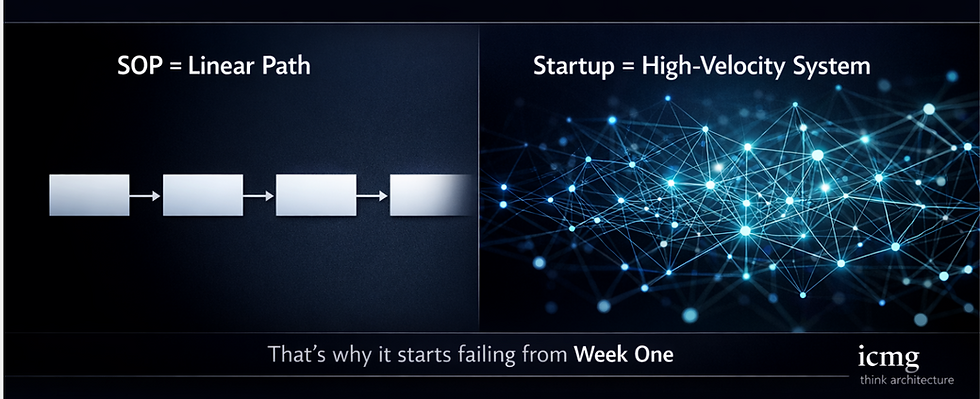
The SOP captures a procedural slice of the startup at one point in time. The startup, however, is not a static procedure. It is a continuously evolving execution system under uncertainty.
→ SOP = linear path
→ Startup = high-velocity, continuously adapting system
It is a moving cross-functional system of product iterations, customer feedback loops, investor expectations, cash flow constraints, hiring changes, technology shifts, and daily experimentation.
That is why the document starts moving toward irrelevance almost immediately. Not after months. From week one.
Case 1 — Founder Decision Breaks the Flow
In the first week itself, a founder or leadership team makes a call to accelerate growth or close a key opportunity.
The SOP defines:→ Standard onboarding flow→ Standard product configuration→ Standard sales or delivery sequence
But the new direction requires:→ Custom solution for a key customer→ Faster onboarding outside defined steps→ Product changes mid-flow→ Cross-team coordination beyond defined roles
The SOP still says one thing. The startup now needs something else.
Teams improvise. Engineers push quick fixes. Sales closes with promises not yet built. Operations adjusts manually.
From that moment onward, the SOP is no longer the real operating reference.
Case 2 — Growth Spike or Pivot Changes Everything
A campaign works. A feature goes viral. Or the startup pivots.
Demand shifts → Product changes → Pricing evolves → Customer segments change → Support load increases → Tech architecture adjusts → Hiring priorities shift
👉 The SOP is already behind the operating reality
→ Workflows are bypassed→ Validation steps are skipped or redefined→ Temporary processes emerge→ Customer handling becomes situational→ Teams coordinate through Slack, calls, and quick decisions→ Metrics and dashboards keep changing
The document still reflects the original flow. The startup is now operating on a different one.
What Happens Next
Founders and early team members start holding the system together through judgment.
Decisions are made across product, tech, sales, finance, and operations—often in real time.
New joiners don’t follow the SOP. They learn from people.
Execution starts happening through:→ Conversations→ Slack threads→ Calls and stand-ups→ Shared context, not documented logic
The SOP remains in place. But it is no longer the real operating reference.
The Deeper Reality
👉 The startup organism evolves in real time through market feedback, funding pressure, and product discovery.
The cost of continuously updating SOPs across product, tech, growth, operations, and support becomes impractical. So nothing gets updated.
Because the document cannot hold:→ Rapid product changes→ Cross-functional decision dependencies→ Market-driven shifts in direction→ Execution variations across people, tools, and stages
Teams stop using it because it does not reflect how the startup actually runs.
Typical Pattern
Investment: founders + early team time across product, tech, sales, and operations
Time to create: days or weeks (not months, but still effort-heavy)
Stakeholders: founders, engineers, growth, operations
Time of actual relevance: extremely short before reality overtakes it
The Real Question
What is actually holding your startup together right now…
→ The SOP document?
→ Your tools and workflows?→
Or the memory of a few founders and early team members who understand how things actually work?


Here are 6 diagnostic questions how startups actually operate:
1.If your SOP is followed exactly, what ensures your startup can still respond to a sudden customer or founder-driven change?
2.Where does your team rely on Slack, calls, or founder instructions instead of the documented process?
3.When product or pricing changes mid-cycle, how is execution logic updated across sales, tech, and operations?
4.How do new hires learn how work actually gets done in your startup?
5.When demand spikes or a pivot happens, what breaks first—process, systems, or coordination?
6.Today, what is actually holding your startup together—documents, tools, or a few individuals?
This diagnostics note explains
why does SOP says one thing while the startup needs something else.