

IT Change Anatomy Visibility Scan™

Updated: Apr 26
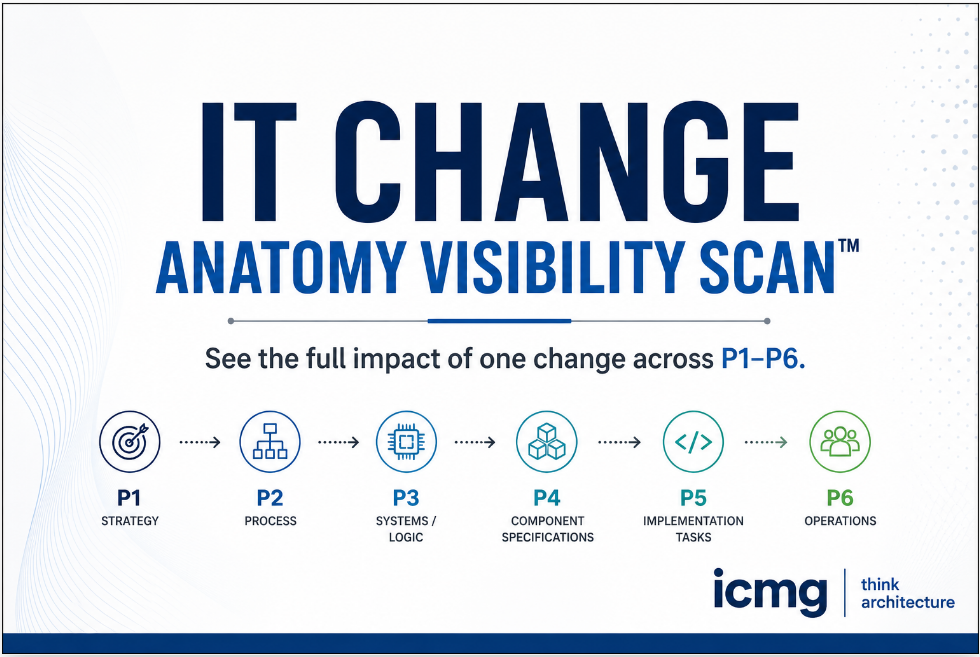
A 5-Day Change Impact Visibility Instrument Across P1–P6
The Premise
Enterprises assume IT change is under control because:
systems are running
releases are scheduled
teams are aligned
tickets are tracked
But execution continuity during change is rarely visible. A change request may be approved. A release may be completed.
But if the enterprise cannot demonstrate how that change travels across:
P1 Strategy → P2 Process → P3 Systems / Logic → P4 Component Specifications → P5 Implementation Tasks → P6 Operations
then the change is being executed through interpretation, not anatomy.
What This Instrument Measures
IT Change Anatomy Visibility Scan™ measures whether a change can be demonstrated end-to-end without relying on explanation, memory, or individual expertise.
It evaluates:
whether the originating business decision is clearly defined (P1)
whether impacted process sequences are visible across departments (P2)
whether system and sub-system logic are traceable across rules, functions, UI, data, and timing logic (P3)
whether impacted components, fields, interfaces, and boundaries are explicitly identified (P4)
whether implementation tasks are clearly defined across files, services, configurations, and release activities (P5)
whether operational behavior, monitoring, exception handling, and service execution are aligned (P6)
The result is not a review of code or systems. It is a measurement of change visibility across the enterprise anatomy.
Why This Matters
Most IT change failures are not caused by coding defects. They are caused by invisible impact. When the full change chain is not visible:
impact analysis expands after development starts
dependencies surface late
testing scope increases unpredictably
production defects appear in adjacent areas
operations create manual workarounds
release cycles extend
rollback risk increases
The enterprise is not failing to implement change. It is failing to see the full consequence of change before execution begins.
How Visibility Gaps Translate to Financial Exposure
When IT change is not anatomically visible:
change cycles extend beyond planned timelines
rework increases across multiple teams
testing effort expands beyond original scope
production incidents require remediation
operational cost increases due to manual handling
business initiatives are delayed
For a typical platform change, this results in:
delay cost across business and IT teams
rework cost due to late discovery of dependencies
testing expansion cost from unclear impact boundaries
defect correction cost post-release
operational workaround cost after deployment
The exposure is not a single failure event. It accumulates across each stage of the change lifecycle.
Scenario Illustration
A change is introduced to modify eligibility logic in a retail lending platform. The change is approved and implemented. However, no single view demonstrates:
how the decision originated
how process sequencing changes across onboarding and approval
how system logic adjusts across scoring, validation, and workflow
which data fields, APIs, and screens are impacted
which implementation tasks modify system behavior
how operations must adjust post-release
The system functions. The change is deployed. But the enterprise cannot demonstrate the full execution chain. That is a visibility gap.
Use Case 1
CHANGE - Eligibility Rule Update 👉 When One IT Change Happens — What Actually Moves?
P1 Strategy
Fast-track approval for high-income customers →
P2 Process
Application → Eligibility → Approval → Disbursement
→
P3 Systems / Logic
Eligibility Rule | Risk Logic | Approval Workflow | UI Logic | API Responses
→
P4 Components
Customer_Income Field | Eligibility API | Loan Screen | Rule Engine | DB Tables
→
P5 Implementation Tasks
eligibility_rules.js /update | Eligibility API | UI Form Update | Config Change |
Test Case TC_01–TC_20
→
P6 Operations
Branch Handling | Call Center Script | Exception Handling | Monitoring
Note: If you cannot trace this end-to-end — the change is not visible.
The 5-Day Instrument
The scan selects one real change scenario and maps it across P1–P6.
It produces a demonstrable view of:
the originating decision
process impact
system and sub-system logic interaction
component-level changes
implementation tasks
operational implications
This is not documentation. It is execution visibility under change conditions.
What Is Delivered
IT Change Anatomy Visibility Score
End-to-end P1–P6 Change Trace
Hidden Dependency Map
System / Data / UI / API Impact View
Testing Scope Visibility
Release Risk Snapshot
Operations Impact Summary
Financial Exposure Estimate
Executive-Level Visibility Brief
When This Becomes Critical
This instrument becomes necessary when:
change impact analysis takes excessive time
releases are delayed despite planning
testing scope expands unpredictably
defects appear outside the expected scope
dependency on specific individuals or vendors is high
business and IT alignment breaks during change
regulatory or audit-driven changes are approaching
Positioning
This is not an architecture review. It is not a transformation program. It is not a documentation exercise. It is a measurement of whether IT change is visible across enterprise anatomy.
Pricing
The 5-day instrument is positioned as an entry diagnostic.
Pricing reflects:
change complexity
number of systems and interfaces
regulatory exposure
enterprise scale
It is typically a small fraction of the cost created by one delayed or misaligned change.
IT Change Anatomy Visibility Scan™ makes one real change fully visible across P1–P6 and quantifies the exposure created when impact is not understood before execution begins.

Comments