

12 Part Series to Diagnose Recurring Problem Across Real Estate Enterprises
- Sunil Dutt Jha

- Dec 27, 2025
- 4 min read
Why This Series Exists
This 12-part Real Estate Enterprise Anatomy™ series was created to diagnose a recurring problem across real estate enterprises:
Critical enterprise behaviors exist in practice, but were never anatomically defined.
As a result, enterprises operate on departmental memory, tool-specific logic, and human coordination — until scale, regulation, capital pressure, or scrutiny exposes the gaps.
This series makes those invisible gaps explicit.
Why Traditional Fixes Keep Failing
Across industries, the response to these problems is predictable:
Add more dashboards
Tighten governance
Implement another platform
Run a transformation program
Hire consultants to “optimize”
But optimization operates inside anatomy. It cannot create anatomy.
Digitization accelerates what exists. It cannot stabilize what was never defined.
This is why enterprises can modernize for years and still repeat the same failures—just faster and with better tools.
The Executive Shift This Series Demands
This series does not propose a new framework, operating model, or transformation roadmap.
It demands a shift in executive thinking:
From asking
Why is this function underperforming?
To asking
Was this enterprise behavior ever anatomically defined?
When anatomy is explicit, execution becomes predictable. When anatomy is implicit, execution depends on people—and eventually fails.
The Foundation: Real Estate Enterprise Anatomy™
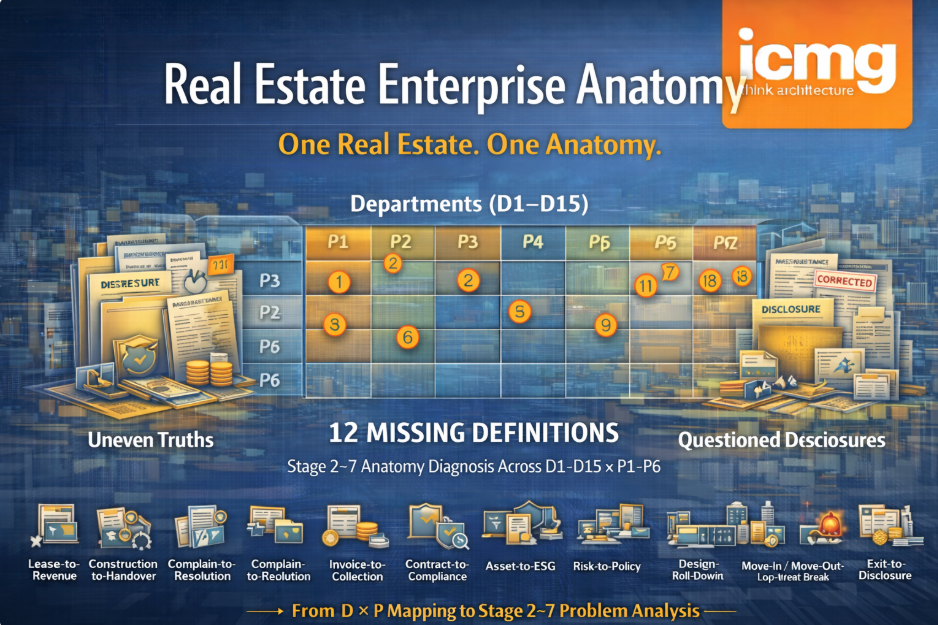
Every real estate enterprise has a single underlying anatomy, regardless of size, geography, or asset class.
That anatomy can be mapped as:
D1–D15: Enterprise Departments (Organ Systems)
Examples include Leasing, Finance, Facilities, Projects, ESG, Risk, Compliance, Asset Management, IT, Board Office, etc.
P1–P6: Execution Perspectives
P1 – Strategy: Intent, outcomes, and value objectives
P2 – Process: Enterprise flows across departments
P3 – System / Logic: Business rules, event logic, thresholds
P4 – Components: Systems, data, contracts, assets, documents
P5 – Implementation Tasks: People + IT build/change tasks
P6 – Operations: Day-to-day execution and monitoring
This series shows that every failure occurs when a D × P intersection was never defined.
Expressions differ. Systems differ. Organizations differ.
But the underlying anatomy does not—the way strategy, logic, and operations must connect—
Until that anatomy is made explicit, enterprises will continue to:
Treat symptoms
Patch gaps
Blame execution
Over-invest in tools
Under-explain failure
Once anatomy is explicit, something fundamental changes:
Execution stops being heroic. Automation starts working. Governance becomes structural. Trust becomes predictable.
The 12 Use Cases —
Each use case represents one enterprise behavior that exists in reality but was never anatomically designed.
Lease-to-Revenue Breakdown Lease execution is not structurally linked to revenue recognition, arrears logic, and occupancy outcomes.
Construction-to-Handover Disconnect Project completion is not anatomically connected to asset readiness, lifecycle logic, or operations.
Tenant Complaint-to-Resolution Gap Complaints are closed operationally without enterprise logic for safety, escalation, and accountability.
Invoice-to-Collection Inefficiency Billing exists without enterprise rules governing disputes, adjustments, and cash realization.
Contract-to-Compliance Miss Legal obligations are digitized but not translated into enforceable operational behavior.
Asset-to-ESG Traceability Failure ESG reporting is disconnected from asset-level processes and system logic.
Risk-to-Policy Isolation Risks are identified but do not structurally alter SOPs, thresholds, or operating constraints.
Development Design-to-Permit Mislink Design evolution is not continuously validated against zoning and permit logic.
Portfolio Plan-to-Subsidiary Roll-Down Failure Portfolio intent is not decomposed into executable subsidiary-level anatomy.
Move-In / Move-Out-to-Dues Closure Gap Tenant transitions lack enterprise closure across finance, utilities, assets, and access.
Preventive-to-Reactive Maintenance Loop Break Preventive signals exist but lack enforcement authority and feedback loops.
Asset Exit-to-Disclosure MismatchExit decisions are not anatomically linked to financial, risk, and regulatory disclosure logic.
Each use case has a clear address in the Real Estate Enterprise Anatomy (D × P).
How ICMG Approaches These Use Cases (Consistently)
The approach is the same across all 12 cases.
Step 1: Map the Enterprise Anatomy
Identify the departments involved (D1–D15)
Identify the enterprise behavior that must exist across them
This immediately shows where execution depends on memory instead of structure.
Step 2: Apply Stage 2–7 Problem Analysis
Stage 2–7 is not a post-mortem. It is a structural diagnostic sequence:
Stage 2 (P1): Is there a shared enterprise intent or only departmental strategies?
Stage 3 (P2): Does an explicit enterprise process exist, or only SOPs?
Stage 4 (P3): Are business rules explicit, or embedded in systems and people?
Stage 5 (P4): Are components aligned to enterprise behavior or departmental needs?
By the end of Stage 5, the enterprise understands what anatomy is missing.
Step 3: Refine P5–P6 (Only After Anatomy Is Clear)
Only once P1–P4 are explicit do we address:
P5 – Implementation TasksTasks are derived from anatomy, not incidents.
P6 – OperationsOperations become explainable, predictable, and governable.
This reverses the typical approach where tasks and operations are adjusted blindly.
How This Is Different from Conventional Approaches
Conventional Approach | Enterprise Anatomy™ Approach |
Starts with tools or transformation | Starts with anatomy |
Fixes incidents | Defines enterprise behavior |
Optimizes departments | Aligns the organism |
Automates assumptions | Enforces logic |
Scales effort | Scales understanding |
Traditional methods operate inside anatomy.They cannot create anatomy.
The Value Proposition (Executive-Level)
When enterprise anatomy is made explicit:
Revenue leakage becomes diagnosable
Automation starts working as intended
Governance becomes structural, not procedural
ESG and compliance become traceable, not narrative
Risk turns into enforced behavior, not awareness
IT stops acting as a compensating organ
Most importantly:
Execution stops depending on people remembering what the enterprise never defined.
Executive Note
These twelve use cases are not twelve problems.
They are twelve missing anatomical definitions inside the same real estate organism.
Once anatomy is explicit, execution becomes predictable — not because teams work harder, but because the enterprise finally knows how it is built.
That is what One Real Estate. One Anatomy™ actually means.
Interested in a Diagnosis of Your Lease-to-Revenue Anatomy?
This case illustrates how the Stage 2–7 Problem Analysis Framework exposes what was never architected in a critical enterprise flow.
ICMG applies this diagnostic method across real estate enterprises to surface missing anatomy before technology investments, automation programs, or transformation initiatives are launched.
Organizations seeking to assess their own Lease-to-Revenue anatomy — or any other core real estate use case — may engage ICMG for an enterprise anatomy diagnosis tailored to their context.
Copyright & Attribution
The Stage 2–7 Problem Analysis Framework, One Real Estate One Anatomy™, and ICMG Enterprise Anatomy™ are proprietary intellectual property of ICMG (Internet Component Management Group).
This article is part of ICMG’s Real Estate Enterprise Anatomy diagnostic series and is intended solely for strategic and architectural analysis. Reproduction or derivative use without attribution is not permitted.


Comments