Is “Improve On-Time Performance” a Goal, Strategy, or Departmental Objective?
- Sunil Dutt Jha

- 9 hours ago
- 10 min read
Most strategy confusion begins because enterprises label statements too early. A phrase like “improve on-time performance” is not automatically a goal, strategy, KPI, or enterprise objective. Its role depends on which anatomy it belongs to: project, department, or enterprise.

Organizations use words like goal, objective, strategy, initiative, outcome, and KPI very loosely.
A leadership team may say:
Increase revenue. Improve customer experience. Improve on-time performance. Reduce cost. Improve aircraft utilization. Reduce disruption. Digitize operations. Improve service quality.
These statements sound strategic.
But in ICMG Enterprise Anatomy™ terms, they are not automatically enterprise strategy.
They may be goals. They may be departmental objectives. They may be project goals.
They may be strategy elements. They may be KPIs.
Their meaning depends on where they sit in the anatomy.
That is why the same phrase can be a goal in one anatomy, a strategy element in another anatomy, and a KPI in a third anatomy. Without locating the statement inside the right anatomy, the enterprise starts confusing ambition with strategy.
That is where execution confusion begins.
There are three anatomies to separate
The confusion becomes easier to solve when we separate three levels:
Project Anatomy
Department Anatomy
Enterprise Anatomy
Each level has its own goals, strategies, processes, systems/sub-system logic, components, implementation tasks, and operations.
A project goal is not automatically a department strategy.
A department objective is not automatically an enterprise goal.
An enterprise strategy is not merely one department’s priority written in a board deck.
This distinction is critical.
Project Anatomy
A project may have a goal such as:
Implement a new baggage tracking system.
At the project level, that is a project goal.
The project strategy may be:
Use RFID-based tracking across check-in, loading, transfer, and arrival points to reduce baggage mishandling and improve passenger visibility.
This is meaningful inside project anatomy.
The project must define:

P1 Strategy — why this project exists and what value it must produce.
P2 Process — which project and business activity sequences must change.
P3 Systems / Logic — which tracking, exception, handover, scanning, location, and alert logic must govern the work.
P4 Component Specifications — which tags, scanners, screens, alerts, dashboards, datasets, workflows, reports, and airport interfaces must carry that logic.
P5 Implementation Tasks — what must be configured, tested, trained, deployed, integrated, and changed.
P6 Operations — how baggage tracking will be run, monitored, corrected, supported, and maintained daily.
At the project level, the anatomy is valid. But the project goal is not automatically enterprise strategy.
It becomes enterprise-relevant only when connected to broader airline anatomy: customer experience, airport operations, baggage operations, flight operations, partners, finance, IT/data, and operations control.
Department Anatomy
A department has its own objectives.
For example, in an airline:
Customer Experience Department Objective: Improve passenger experience during delay, disruption, rebooking, and recovery.
Sales and Distribution Objective: Increase revenue through better channel conversion, ancillary offers, and partner distribution.
Operations Control Objective: Reduce disruption recovery time.
Maintenance and Engineering Objective: Improve aircraft availability and reduce maintenance-related delay.
Airport Operations Objective: Improve gate turnaround reliability.
Each of these can be valid as a departmental objective.
But each department can also push its own objective upward and call it enterprise strategy. That is where distortion begins.
Sales may push increase revenue as the enterprise strategy.
Customer Experience may push improve passenger experience as the enterprise strategy.
Operations may push improve on-time performance as the enterprise strategy.
Maintenance may push improve aircraft availability as the enterprise strategy.
Finance may push reduce cost as the enterprise strategy.
Each department may be right from its own anatomy. But the enterprise is not one department. So a departmental objective becomes enterprise-level only when it is tested against the full enterprise anatomy (P1-P6 X D1-D15).
Enterprise Anatomy (P1-P6 X D1-D15)
Enterprise Anatomy asks a harder question:
Can the enterprise coordinate multiple departmental objectives into one coherent value outcome?
Case 1: increase revenue
In an airline, increase revenue may look like an enterprise goal.
But anatomically, it may originate strongly from Sales, Revenue Management, Distribution, Loyalty, Product, and Customer Experience.
It still needs support from airport operations, flight operations, crew planning, maintenance, safety, finance, IT/data, partners, and operations control.
Case 2 : improve on-time performance
Similarly, improve on-time performance may look like an enterprise goal.
But anatomically, it may originate strongly from Operations, Customer Experience, Flight Operations, Airport Operations, Crew Planning, Maintenance, and Operations Control.
It still affects revenue, cost, loyalty, passenger recovery, safety, partner coordination, finance, and IT/data.
So the enterprise goal cannot simply be one department’s goal promoted upward.
A real enterprise goal must be the integrated outcome of multiple departments, sub-functions, constraints, dependencies, and value flows.
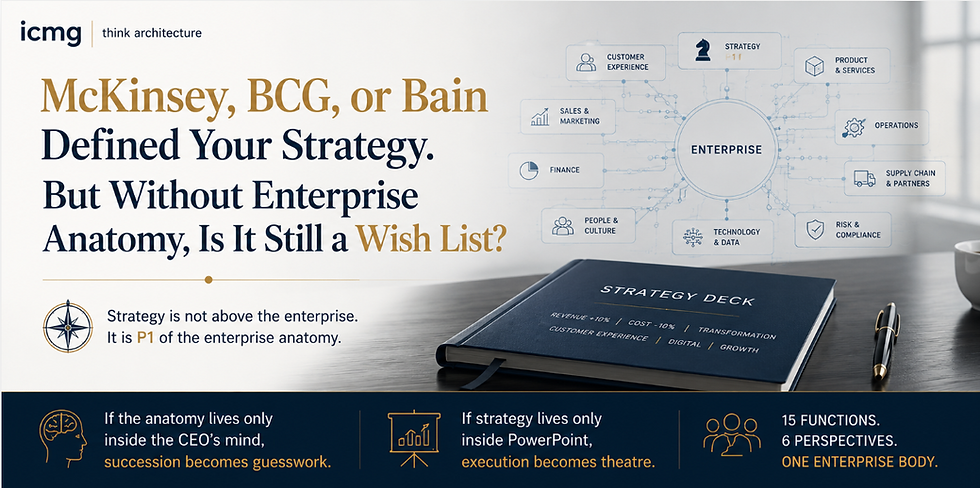
That is why ICMG Enterprise Anatomy™ examines the enterprise through D1–D15 × P1–P6.
D1–D15 represent the enterprise departments or functions.
P1–P6 represent the six perspectives from strategy to operations.
Only then can we see whether a goal is truly enterprise-level, or merely a departmental objective wearing enterprise language.
“Improve on-time performance” is not automatically strategy
Take the phrase:
Improve on-time performance.
This phrase is not inherently a goal or a strategy.
Its role depends on where it sits in the anatomy.
At the Customer Experience department level, it may be an objective because passengers experience delays directly.
At the Operations Control level, it may be an objective because the control center manages disruption, recovery, and operational stability.
At the Flight Operations level, it may be an objective because dispatch readiness, flight planning, crew briefing, and operational control affect departure and arrival performance.
At the Airport Operations level, it may be an objective because gate readiness, boarding, baggage loading, cleaning, fueling, catering, and ground handling affect turnaround.
At the enterprise level, it may be a strategy element supporting higher enterprise goals such as revenue growth, loyalty improvement, brand trust, cost reduction, operational reliability, and competitive positioning.
At the project level, it may become a project goal for a turnaround optimization initiative, airport operations digitization, or disruption recovery program.
So the phrase itself does not tell us whether it is goal or strategy. Its anatomical position tells us.
Goal, strategy element, or KPI?
A goal states what must improve.
A strategy defines the chosen means, value logic, resource direction, and trade-off pattern for achieving that goal.
A KPI measures whether the expected result is being achieved.
But the same phrase can move between these roles depending on level.
For example:
Enterprise Goal: Increase revenue through stronger passenger loyalty, better reliability, and higher repeat bookings.
P1 Strategy Element: Improve on-time performance to increase customer trust, reduce disruption dissatisfaction, protect loyalty value, and improve repeat purchase behavior.
Department Objective: Improve on-time performance in Airport Operations, Flight Operations, Crew Planning, Maintenance, and Operations Control.
Project Goal: Reduce average turnaround delay by improving gate readiness, boarding sequence, baggage loading, and ground handling coordination.
KPI: Percentage of flights departing within 15 minutes of scheduled departure time.
This is the clean separation.
The phrase “improve on-time performance” may be a strategy element at enterprise level, a departmental objective at operations level, a project goal at project level, and a KPI category at measurement level.
That is why language alone is not enough. The enterprise must know which anatomy the phrase belongs to.
Why departmental goals are often mistaken for enterprise strategy
Most enterprises do not suffer from lack of strategy language. They suffer because departmental objectives are promoted as enterprise strategy without being tested against enterprise anatomy.
A sales department may say:
Increase revenue.
But if the airline cannot protect schedule reliability, passenger experience, billing accuracy, partner delivery, airport service, and disruption recovery, revenue growth may not hold.
A customer experience department may say:
Improve passenger experience.
But if crew, maintenance, airport operations, baggage, flight operations, revenue rules, finance, and IT/data are not aligned, customer experience improvement remains local.
An operations department may say:
Improve on-time performance.
But if schedule planning creates unrealistic turnaround assumptions, maintenance clearance is delayed, crew positioning is weak, baggage loading is inconsistent, and passenger recovery is poor, on-time performance becomes a shared enterprise problem.
A finance department may say:
Reduce cost.
But if cost reduction weakens aircraft readiness, crew resilience, ground handling quality, customer recovery, or system support, the enterprise may reduce cost in one place and lose value elsewhere.
This is why enterprise strategy cannot be declared by one department. It must be diagnosed across the enterprise body.
A real enterprise goal must survive anatomy testing
A statement becomes enterprise-level only when it passes anatomy testing. The enterprise must ask:
Which departments must carry this goal?
Which sub-functions are involved?
Which departmental objectives support or conflict with it?
Which P1 strategy elements are required inside each department?
Which processes must change?
Which business system/sub-system logic must govern the change?
Which component specifications must carry the logic?
Which human and IT tasks must be implemented?
Which business and IT operations must monitor and sustain the outcome?
Which timelines, people, products, services, locations, customer segments, partners, and risk conditions are involved?
If the organization cannot answer these questions, the statement may still be important. But it has not yet become enterprise strategy. It is still a goal, aspiration, or departmental priority.
One enterprise strategy is a network of strategy elements
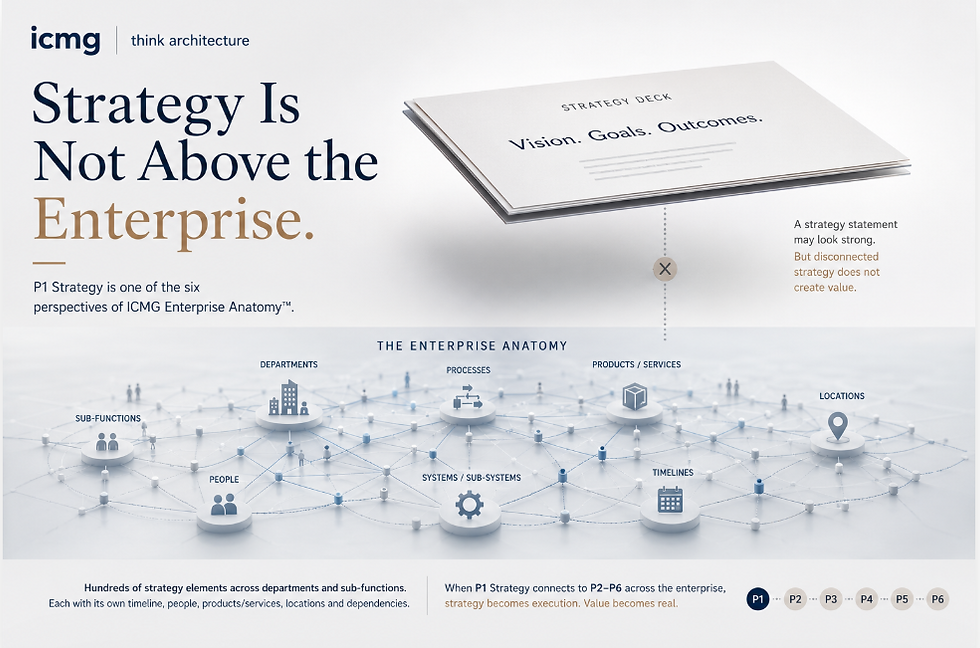
Most organizations speak of “enterprise strategy” as if it is one clean direction. But in a real enterprise, strategy is not one statement. It is a network.
A large enterprise may have 15 major departments or functions.
Each department may have 10 to 15 sub-functions.
Each sub-function may carry 2 to 3 strategy elements.
That means one enterprise strategy may depend on 450 to 675 connected strategy elements before the organization even reaches process, systems, components, implementation, and operations.
This changes the conversation completely. The enterprise does not fail because people did not understand the headline strategy.
It fails because the strategy was never decomposed into the actual P1 Strategy elements across departments and sub-functions — and then connected to P2–P6.
Each strategy element has its own variables.
It may have its own timeline.
It may involve specific people, roles, teams, or partners.
It may apply to certain products or services.
It may apply differently by geography, branch, airport, plant, market, customer segment, channel, or regulatory zone.
It may carry different revenue, cost, risk, service, compliance, or operational implications.
It may depend on other strategy elements inside the same department or across other departments.
So P1 Strategy is not a single box.
P1 Strategy is one of the six perspectives of ICMG Enterprise Anatomy™. It contains the direction and value outcomes that must be decomposed across departments, sub-functions, timelines, people, products, services, locations, and dependencies.
Only then can those strategy elements be connected to the remaining five perspectives of ICMG Enterprise Anatomy™.
The P1–P6 trace must be enterprise-wide, not IT-centric
Once the P1 Strategy elements are clear, they must be traced into P2–P6.
But this trace must not be interpreted as IT-only.
P2 Process is the activity sequence through which the department realizes the strategy element.
P3 Systems / Logic is the business system and sub-system logic that governs how the department works. This includes policy logic, rule logic, decision logic, workflow logic, data logic, timing logic, approval logic, exception logic, people coordination logic, partner logic, and where relevant, IT system logic.
P4 Component Specifications are the concrete components that carry or express that logic. These may include forms, templates, role definitions, policy clauses, approval matrices, service rules, operating checklists, reports, dashboards, datasets, screens, APIs, workflows, configurations, training material, contracts, or physical and digital assets.
P5 Implementation Tasks are the work required to create, change, deploy, or improve those components. This includes human tasks within the department and IT tasks supporting that department.
P6 Operations are the daily business operations and IT operations required to run, monitor, support, correct, and maintain the department’s work.
This is where many EA discussions go wrong.
P3 is not only IT systems.
P4 is not only IT components.
P5 is not only IT implementation.
P6 is not only IT operations.
Every department has its own anatomy.
Every department has processes, systems/sub-system logic, components, tasks, and operations.
IT may support many of them. But IT does not replace the department’s anatomy.
Airline example: when on-time performance becomes enterprise-level
Let us take the airline example again.
Improve on-time performance may start as an operations objective.
But it can become enterprise-level when the airline proves that on-time performance affects:
passenger trust, repeat bookings, brand reputation, ancillary revenue, connection reliability, crew cost, fuel cost, maintenance planning, aircraft utilization ,airport slot reliability, partner coordination, compensation cost, customer recovery, and market competitiveness.
Now it is no longer a narrow department objective. It is part of enterprise value logic.
But that still does not make the phrase itself complete strategy.
The airline must define the P1 Strategy elements across the relevant departments.
Network Planning must understand how routes affect operational pressure.
Schedule Planning must understand block times, connection windows, aircraft rotations, and slot constraints.
Crew Planning must understand duty limits, reserves, crew positioning, and disruption recovery.
Maintenance & Engineering must understand aircraft availability, defect clearance, maintenance windows, and spare parts readiness.
Airport Operations must understand gate allocation, boarding, baggage, cleaning, catering, fueling, and ground handling.
Flight Operations must understand dispatch readiness, flight planning, operational control, and recovery actions.
Safety & Compliance must ensure that speed does not weaken safety, fatigue rules, or regulatory obligations.
Customer Experience must manage communication, rebooking, compensation, complaints, and recovery.
Revenue Management must understand how reliability affects fares, load factor, demand, and yield.
Finance must trace delay cost, compensation cost, crew cost, fuel cost, missed connections, and revenue loss.
IT & Data must ensure that alerts, dashboards, workflows, data, APIs, and operational systems carry the same delay logic.
Partners must align airports, ground handlers, alliance partners, hotels, caterers, maintenance partners, and service providers.
Operations Control must coordinate the real-time recovery of aircraft, crew, passengers, and schedule.
So “improve on-time performance” is not enterprise strategy by itself. It becomes enterprise-level only when the airline can show how it moves through the enterprise anatomy.
Otherwise, every department interprets the target from its own position. That is not enterprise strategy. That is distributed guessing.
Why this matters for strategy clarity
This distinction solves the goal-versus-strategy confusion.
A phrase is not inherently a goal.
A phrase is not inherently a strategy.
A phrase is not inherently a KPI.
Its role depends on the anatomy level and its relationship to other elements.
At the project level, it may be a project goal.
At the department level, it may be a departmental objective.
At the enterprise level, it may be a strategy element supporting a larger value outcome.
At the operations level, it may become a KPI.
That is why “increase revenue,” “improve customer experience,” and “improve on-time performance” cannot be accepted as enterprise strategy just because they appear in a strategy deck.
They must be anatomically located. Only then can the enterprise know what they are.
The board-level question
For a board, CEO, ministry, CIO, CFO, COO, Chief Strategy Officer, or transformation leader, the question is not:
Do we have enterprise strategy?
The better question is:
Which anatomy does each strategy statement belong to?
Is it a project goal?
Is it a department objective?
Is it a strategy element inside P1?
Is it a KPI?
Is it a true enterprise-level outcome?
Can it be traced across departments, sub-functions, timelines, people, products, services, locations, dependencies, processes, systems/sub-system logic, component specifications, implementation tasks, and operations?
If not, the organization may have strategy language. But it does not yet have strategy clarity.
Diagnostic Question
When your organization says “increase revenue,” “improve customer experience,” “reduce cost,” or “improve on-time performance,” what exactly is it?
A project goal?
A department objective?
A strategy element?
An enterprise-level outcome?
A KPI?
Can your organization locate it inside project anatomy, department anatomy, or enterprise anatomy?
Can it trace that statement across P1 Strategy, P2 Process, P3 Systems / Logic, P4 Component Specifications, P5 Implementation Tasks, and P6 Operations?
If not, the enterprise may not have strategy. It may have departmental objectives promoted as enterprise ambition.


Comments