If Enterprise Anatomy Lives Only Inside the CEO’s Mind, Succession Becomes Guesswork
- Sunil Dutt Jha

- 8 hours ago
- 6 min read
The issue is not only who becomes the next CEO. The issue is whether the enterprise anatomy has been made explicit before the transition. Strategy cannot live only in PowerPoint. Enterprise Anatomy cannot live only inside one leader’s mental model.

CEO succession is usually discussed as a leadership question.
Was the successor ready? Was the board aligned? Was the outgoing CEO supportive?Was the strategy clear? Was the transition well communicated? Was the new leader accepted by the organization?
These questions matter.
But there is a deeper diagnostic question:
Did the enterprise anatomy live inside the company — or only inside the mind of the outgoing leader?
A long-serving founder or CEO may not merely know the business. They may carry the enterprise anatomy inside their mental model.
They understand how decisions move. They understand which organs of the enterprise are strong or weak. They understand which departments quietly depend on each other. They understand which numbers are real signals and which are noise. They understand where value is created, protected, delayed, or leaked.
They understand which risks are visible and which are hidden. They understand which people, processes, systems, partners, and operations quietly hold the enterprise together.
That knowledge may not exist in one document.
It may not exist in the strategy deck. It may not exist in the operating model. It may not exist in the dashboards. It may not exist in the board papers. It may not exist in the transformation roadmap.
It may live inside the leader. That is the succession risk.
A CEO may carry the enterprise body without naming it
Many exceptional CEOs do not talk about Enterprise Anatomy. But they often operate from it.
They know how the enterprise breathes.
They know which customer decision affects which department. They know which product change will create operational stress. They know which margin improvement will damage service quality. They know which cost reduction will create risk later. They know which system change will trigger process confusion.
They know which partner dependency is fragile. They know which team can absorb change and which team cannot. They know which performance indicator is cosmetic and which one reveals the truth.
This is not only experience. It is internalized anatomy.
The CEO has spent years watching the enterprise as a living body — its organs, relationships, tensions, rhythms, dependencies, and failure patterns. The problem begins when this anatomy is never externalized.
The next CEO may inherit the role. But they may not inherit the anatomy.
GE, Dell, Disney — the diagnostic question
GE after Jack Welch is often discussed as a succession, portfolio, capital allocation, leadership, and strategy case. But another diagnostic question can be asked:
How much of GE’s enterprise anatomy was made explicit, and how much lived inside the mental model built over decades?
This does not mean one leader alone explains everything that happened later. Large enterprises are more complex than that.
But it does raise a serious question for boards:
When a legendary CEO leaves, does the next leader inherit only the title, strategy, targets, and organization chart — or do they inherit the actual anatomy of how the enterprise creates, protects, delays, and loses value?
Michael Dell’s return to Dell also carries a related lesson.
A founder may return not only because of vision or personal authority, but because the enterprise anatomy of the company still lives deeply inside their mental model — customers, channels, products, supply chain, finance, execution rhythms, and market dependencies.
Disney’s leadership transitions also raise a similar question.
When a CEO holds the creative, financial, brand, content, parks, distribution, technology, and culture anatomy of the enterprise in one integrated mental model, the next leader may inherit the position without fully inheriting the anatomy.
This is why succession cannot be treated only as a leadership handover.
It is also an anatomy handover.
Why insiders often perform better than outsiders
This also helps explain why insiders often perform better than outsiders in complex enterprises.
An insider who has spent 20 or 25 years inside the company may already understand the enterprise’s organs, relationships, dependencies, tensions, and hidden decision paths.
They may know where the real power sits.
They may know which processes are formal and which ones actually work.
They may know which systems are critical and which ones are merely visible.
They may know which dashboards are trusted and which ones are theatre.
They may know which partners carry real operational weight.
They may know which departments appear independent but are deeply dependent.
They may understand the anatomy before they receive the title.
An external CEO may bring intelligence, credentials, strategy language, investor confidence, and market experience.
But if they do not understand the enterprise anatomy, they are forced to manage through presentations, dashboards, consultants, operating reviews, and interpretations.
That is dangerous in a complex enterprise.
Because the most important parts of the enterprise are often not visible on day one. They are hidden in decision flows, dependencies, exceptions, operating habits, system logic, partner relationships, and accumulated institutional memory.
At $10B scale, strategy cannot live inside PowerPoint
This becomes critical when the enterprise is managing $10 billion, $50 billion, or $100 billion of value.
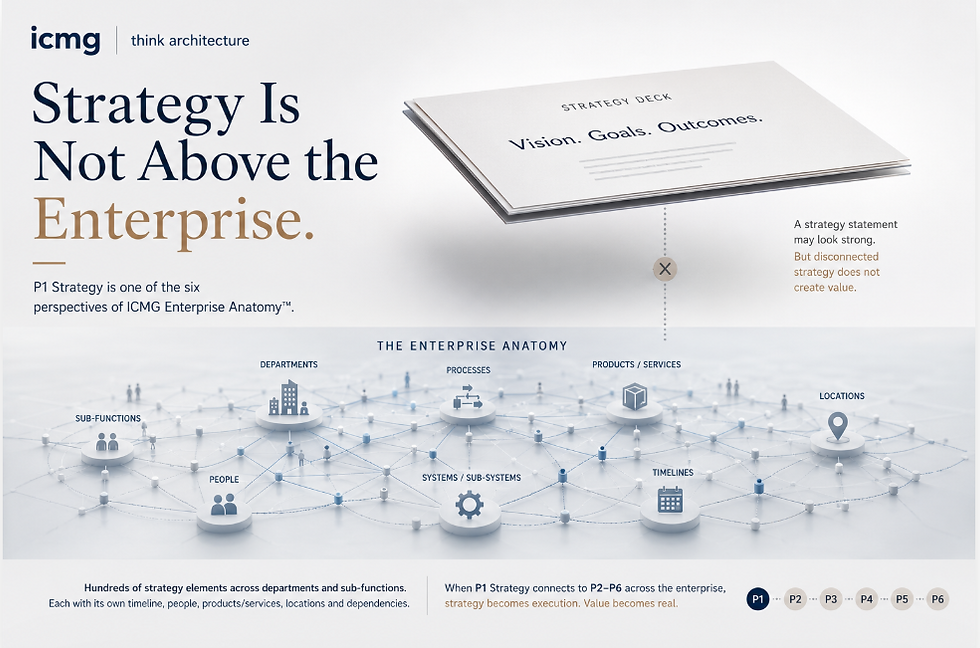
At that scale, strategy cannot be realized inside PowerPoint. Strategy must live inside the anatomy of the enterprise.
It must be traceable across departments, decisions, processes, systems, component specifications, implementation tasks, and operations.
In ICMG Enterprise Anatomy™, this means strategy is not treated as a separate layer above the enterprise.
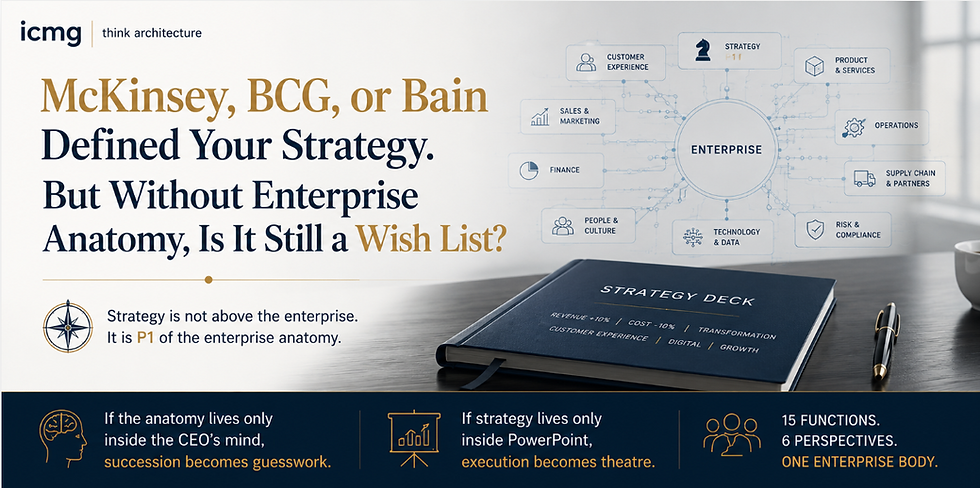
Strategy is P1 of the enterprise anatomy.
But P1 must connect to:
P2 Process — the sequence of activities required to realize the strategy.
P3 Systems / Logic — the rules, data, function, UI, timing, workflow, and integration logic that execute or enforce the process.
P4 Component Specifications — the APIs, screens, datasets, reports, workflows, configurations, rules, and components where that logic is carried.
P5 Implementation Tasks — the build, configuration, modification, testing, deployment, training, and change activities.
P6 Operations — the daily business and IT operations that run, monitor, support, and maintain the service.
And this must be visible across the enterprise functions where work actually happens.
A CEO cannot manage a large enterprise only through ambition, intuition, and dashboards.
The enterprise needs an explicit anatomy.
Succession fails when anatomy is not externalized
When anatomy remains inside one leader’s mind, succession becomes fragile.
The outgoing CEO may understand why certain decisions work. The incoming CEO may only see the formal structure.
The outgoing CEO may know which departments must move together. The incoming CEO may see separate reporting lines.
The outgoing CEO may know which risks are hidden. The incoming CEO may see only the dashboard.
The outgoing CEO may know where value is really created. The incoming CEO may see only the financial summary.
The outgoing CEO may know which operating relationships are fragile. The incoming CEO may discover them only after something breaks.
This is why succession planning must move beyond role replacement. It must include anatomy externalization.
The board should not only ask:
Who is the next CEO?
It should ask:
Can the next CEO see the enterprise anatomy clearly enough to make decisions from day one?
The role of ICMG Enterprise Anatomy™
ICMG Enterprise Anatomy™ makes the enterprise explicit.
It does not rely on memory alone. It maps how strategy, process, systems/logic, component specifications, implementation tasks, and operations connect across the enterprise.
It asks:
Where is value created? Where is value protected? Where is value delayed? Where is value leaking? Which departments depend on each other? Which decisions move across functions? Which processes carry those decisions? Which systems and sub-system logic execute them? Which components instantiate them? Which tasks change them? Which operations sustain them?
This is how enterprise knowledge moves from the mind of a leader into a visible enterprise asset. That is not documentation for its own sake. That is leadership continuity.
The board-level question
For a board, CEO, founder, chairperson, investor, or succession committee, the question is not only:
Who is the next CEO?
The better question is:
Has the enterprise anatomy been made explicit enough for the next CEO to lead without depending on the previous CEO’s mental model?
Can the next leader see how decisions move?
Can they see which departments are connected?
Can they see where value is created and leaked?
Can they see which risks are hidden?
Can they see how strategy moves from P1 Strategy to P6 Operations?
Can they see the real enterprise body before they are expected to operate it?
If the answer is no, the succession may look prepared. But the enterprise may still be exposed.
Diagnostic Question
If the CEO leaves tomorrow, what exactly transfers?
A title?
A strategy deck?
A dashboard?
A board mandate?
A transformation roadmap?
Or the explicit anatomy of how the enterprise actually works?
If the anatomy lives only inside the CEO’s mind, succession becomes guesswork. If strategy lives only inside PowerPoint, execution becomes theatre.


Comments