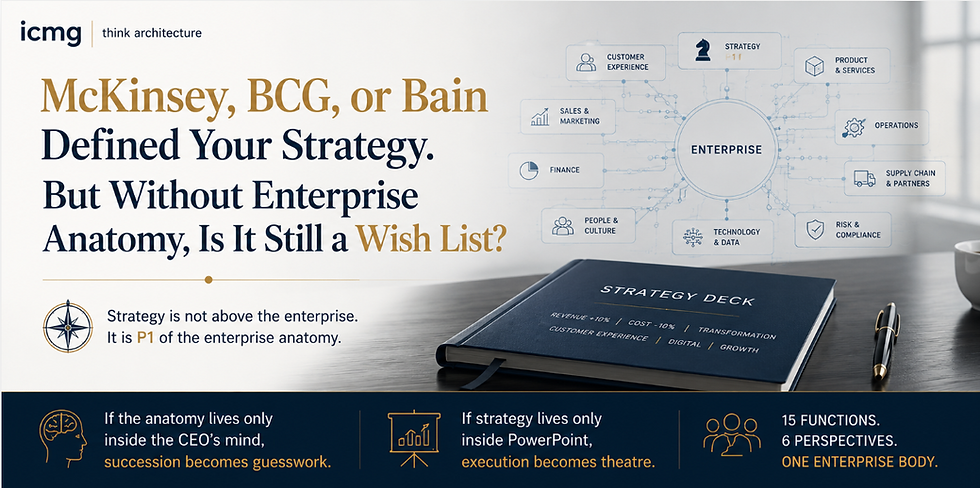
Strategy Is Not Above the Enterprise. P1 Strategy Is One of the Six Perspectives of ICMG Enterprise Anatomy™.
- ICMG Support
- 9 hours ago
- 8 min read

The fundamental error is treating strategy as separate from the enterprise.
For decades, strategy has been treated as if it can be defined as a separate layer above the enterprise.
First strategy. Then operating model. Then initiatives. Then governance. Then execution. Then KPIs.
This sequence looks logical. But it contains a fundamental error. It assumes strategy can be defined first, and the enterprise can execute it later.
That is not how a living system works. An enterprise does not execute strategy because a strategy deck exists. It executes strategy only when the strategy is understood inside the anatomy of the enterprise.
That means strategy must be connected to the departments, processes, rules, systems, component specifications, implementation tasks, and operations that actually create the outcome.
Without that connection, strategy is not yet strategy. It is an executive intent waiting for the enterprise body to understand it.
The purpose of an organ is not understood separately from its anatomy
In a living organism, the purpose of an organ is not defined separately from its anatomy.
The purpose of the lungs is not above lung anatomy. It is understood through lung anatomy.

The lungs are understood through the trachea, bronchi, bronchioles, alveoli, capillary network, diaphragm, intercostal muscles, pleura, nervous control, blood chemistry, and gas exchange.
We do not understand the lungs by saying:
“The lung objective is to improve oxygen performance”
That statement is not enough.
A doctor must ask:
Where does air enter? Where is it distributed? Where does oxygen exchange happen?Where does carbon dioxide leave the blood? What role do alveoli play? What role do capillaries play? What creates breathing motion? What regulates rhythm? What happens when one part fails?
Only then does the function of the lungs become clear.
The same is true for the heart. The purpose of the heart is not above heart anatomy.
It is understood through chambers, valves, arteries, veins, electrical conduction, blood flow, pressure, rhythm, and muscle function.
Function is not separate from anatomy. Function is revealed through anatomy.
The same principle applies to the enterprise.
The brain is not the strategy of the body
There is one more conceptual mistake that must be corrected. People often assume strategy is like the brain of the enterprise.
But even that analogy is incomplete. The brain is not the “strategy” of the human body.
The brain is part of human anatomy. It is one organ within the body, not a layer floating above it.
Its existence is not independent of the body. Its function is not optional. Its meaning is understood only because it exists inside a living anatomical system.
The brain depends on oxygen from the lungs, blood flow from the heart, glucose from metabolism, nerve pathways from across the body, and continuous feedback from multiple organ systems.
It does not operate in isolation. It operates as part of anatomy.
The same is true for strategy in an enterprise. Strategy is not a detached thinking layer sitting above the enterprise. It is not an optional management layer that can be written first and then handed down for others to execute.
P1 Strategy is one of the six perspectives of ICMG Enterprise Anatomy™.
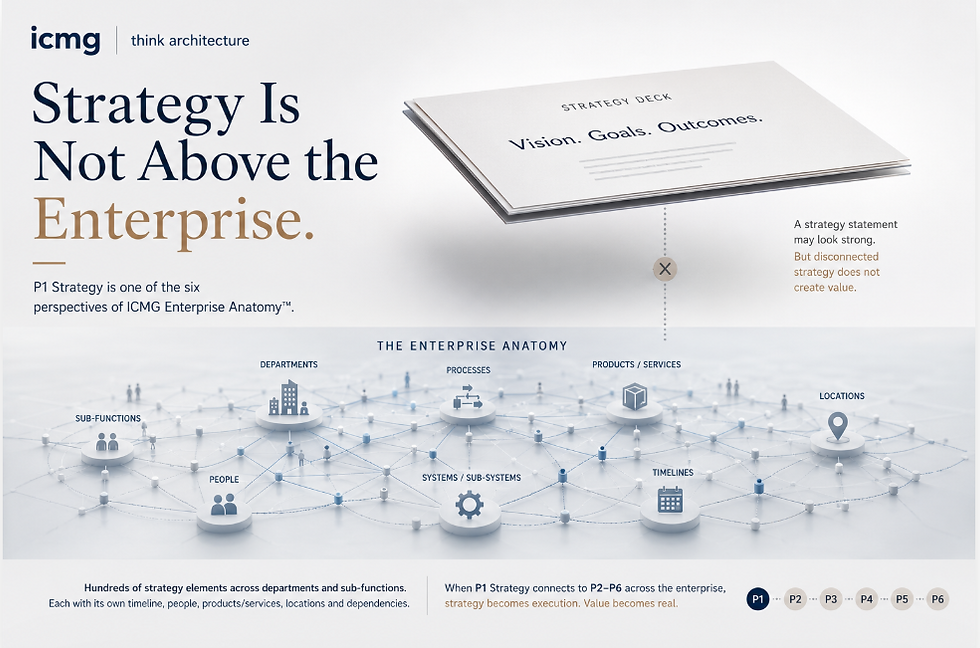
It gives direction and value outcomes, but it becomes meaningful only when connected to P2 Process, P3 Systems / Logic, P4 Component Specifications, P5 Implementation Tasks, and P6 Operations.
So the correction is deeper than saying strategy needs better execution.
The correction is this:
Strategy is not above the enterprise. Strategy is not separate from the enterprise. P1 Strategy is one of the six perspectives of ICMG Enterprise Anatomy™.
And just as the body cannot function because the brain has intent alone, an enterprise cannot execute because leadership has intent alone.
It executes only when strategy, process, systems/logic, component specifications, implementation tasks, and operations work together across the departments where value is actually created.
Strategy is not above the enterprise
The strategy industry often treats strategy as if it sits above the enterprise. The strategy is defined. Then the enterprise is expected to execute. But this creates a dangerous split.

Strategy becomes the thinking layer. Execution becomes the doing layer. Departments become implementation units. Systems become enablers. Operations become follow-through.
That is not anatomy. That is a layered management assumption.
In reality, strategy is not above the enterprise. P1 Strategy is one of the six perspectives of ICMG Enterprise Anatomy™. It is not separate from the rest of the enterprise body.

It must connect to:
P2 Process — the sequence of activities required to realize the strategy.
P3 Systems / Logic — the business system and sub-system logic that governs how the department works. This includes policy logic, rule logic, decision logic, workflow logic, data logic, timing logic, approval logic, exception logic, people coordination logic, partner logic, and where relevant, IT system logic.
P4 Component Specifications — the concrete components that carry or express that logic. These may include forms, templates, role definitions, policy clauses, approval matrices, service rules, operating checklists, reports, dashboards, datasets, screens, APIs, workflows, configurations, training material, contracts, or physical/digital assets.
P5 Implementation Tasks — the work required to create, change, deploy, or improve those components. This includes human tasks within the department and IT tasks supporting that department.
P6 Operations — the daily business operations and IT operations required to run, monitor, support, correct, and maintain the department’s work.
So the correction is simple: Strategy is not separate from anatomy. P1 Strategy is one of the six perspectives of ICMG Enterprise Anatomy™.
A strategy statement is not strategy until the anatomy is visible
A 10% revenue increase is not strategy by itself. A 10% cost reduction is not strategy by itself. A digital transformation ambition is not strategy by itself. A customer experience improvement target is not strategy by itself.
These are desired outcomes. They become strategy only when the enterprise can show how the outcome will be created.
Which departments will create it? Which processes must change? Which rules must shift? Which system and sub-system logic must execute it? Which components carry the logic? Which tasks must be implemented? Which operations must monitor and sustain it?
Until then, the strategy may be clear as language. But it is not clear as enterprise anatomy. That is why many strategies look strong in PowerPoint and weak in execution.
The issue is not always poor leadership, poor communication, or weak change management. Often, the deeper issue is that the strategy was never anatomically defined.
One enterprise strategy is not one strategy
Most organizations speak of “enterprise strategy” as if it is one clean direction. But in a real enterprise, strategy is not one statement. It is a network.
A large enterprise may have 15 major departments or functions.
Each department may have 10 to 15 sub-functions.
Each sub-function may carry 2 to 3 strategy elements.
That means one enterprise strategy may depend on 450 to 675 connected strategy elements before the organization even reaches process, systems, components, implementation, and operations.
This changes the conversation completely.
The enterprise does not fail because people did not understand the headline strategy. It fails because the strategy was never decomposed into the actual P1 strategy elements across departments and sub-functions — and then connected to P2–P6.
Each strategy element has its own variables.
It may have its own timeline. It may involve specific people, roles, teams, or partners. It may apply to certain products or services. It may apply differently by geography, branch, airport, plant, market, customer segment, channel, or regulatory zone. It may carry different revenue, cost, risk, service, compliance, or operational implications. It may depend on other strategy elements inside the same department or across other departments.
So P1 Strategy is not a single box.
P1 Strategy is one of the six perspectives of ICMG Enterprise Anatomy™. It contains the direction and value outcomes that must be decomposed across departments, sub-functions, timelines, people, products, services, locations, and dependencies.
Only then can those strategy elements be connected to the remaining five perspectives of ICMG Enterprise Anatomy™:
P2 Process — the activity sequences through which the department realizes the strategy element.
P3 Systems / Logic — the business system and sub-system logic that governs how the department works. This includes policy logic, rule logic, decision logic, workflow logic, data logic, timing logic, approval logic, exception logic, people coordination logic, partner logic, and where relevant, IT system logic.
P4 Component Specifications — the concrete components that carry or express that logic. These may include forms, templates, role definitions, policy clauses, approval matrices, service rules, operating checklists, reports, dashboards, datasets, screens, APIs, workflows, configurations, training material, contracts, or physical/digital assets.
P5 Implementation Tasks — the work required to create, change, deploy, or improve those components. This includes human tasks within the department and IT tasks supporting that department.
P6 Operations — the daily business operations and IT operations required to run, monitor, support, correct, and maintain the department’s work.
This is why strategy cannot live only in a PowerPoint deck.
A deck may state the ambition. But the enterprise needs to know how hundreds of strategy elements move through its real anatomy. Without this, strategy becomes interpretation. With this, strategy becomes diagnosable.
Airline example: on-time performance
Take an airline strategy:
Improve on-time performance.
This is not one strategy. It is a desired enterprise outcome.
To become strategy, it must be translated into the anatomy of the airline.
Network Planning must understand how routes affect operational pressure.
Schedule Planning must understand block times, connection windows, aircraft rotations, and slot constraints.
Crew Planning must understand duty limits, reserves, crew positioning, and disruption recovery.
Maintenance & Engineering must understand aircraft availability, defect clearance, maintenance windows, and spare parts readiness.
Airport Operations must understand gate allocation, boarding, baggage, cleaning, catering, fueling, and ground handling.
Flight Operations must understand dispatch readiness, flight planning, operational control, and recovery actions.
Safety & Compliance must ensure that speed does not weaken safety, fatigue rules, or regulatory obligations.
Customer Experience must manage communication, rebooking, compensation, complaints, and recovery.
Revenue Management must understand how reliability affects fares, load factor, demand, and yield.
Finance must trace delay cost, compensation cost, crew cost, fuel cost, missed connections, and revenue loss.
IT & Data must ensure that alerts, dashboards, workflows, data, APIs, and operational systems carry the same delay logic.
Partners must align airports, ground handlers, alliance partners, hotels, caterers, maintenance partners, and service providers.
Operations Control must coordinate the real-time recovery of aircraft, crew, passengers, and schedule.
So “improve on-time performance” is not strategy until these departmental P1s are visible and connected to P2–P6. Otherwise, every department interprets the target from its own position.
That is not enterprise strategy. That is distributed guessing.
Why the old sequence fails
The traditional sequence says:
Strategy first. Then operating model. Then initiatives. Then governance. Then execution. Then KPIs.
But the anatomical sequence asks different questions:
What is the strategic outcome? Which departments must carry it? What is the P1 strategy of each department? What processes realize those strategies? What systems and logic execute those processes? What components carry that logic? What tasks must be implemented? What operations must monitor and sustain the outcome?
This is not a minor difference. It changes the definition of strategy.
Strategy is not a standalone document.
P1 Strategy is the first visible perspective of ICMG Enterprise Anatomy™.
If it cannot be traced into P2–P6, it is not ready for execution.
If it cannot be traced across the relevant departments, sub-functions, timelines, people, products, services, locations, and dependencies, it is not yet enterprise strategy.
The board-level question
For a board, CEO, ministry, CIO, CFO, COO, Chief Strategy Officer, or transformation leader, the question is not:
Do we have a strategy?
The better question is:
Can the strategy be traced through the anatomy of the enterprise that must execute it?
Can the enterprise show which departments carry the strategy?
Can each department show its P1?
Can each P1 connect to process, systems/logic, component specifications, implementation tasks, and operations?
Can the organization see where strategy becomes execution?
Can it see where value is created, protected, delayed, or leaked?
If not, the strategy may be approved. But it has not yet become enterprise anatomy.
Diagnostic Question
Is your strategy sitting above the enterprise as a statement of intent?
Or is it visible inside ICMG Enterprise Anatomy™ as P1 Strategy, connected to P2 Process, P3 Systems / Logic, P4 Component Specifications, P5 Implementation Tasks, and P6 Operations across the departments that must execute it?
If strategy is separate from anatomy, execution becomes interpretation.
If P1 Strategy is connected to the remaining five perspectives of ICMG Enterprise Anatomy™, execution becomes diagnosable.


Comments