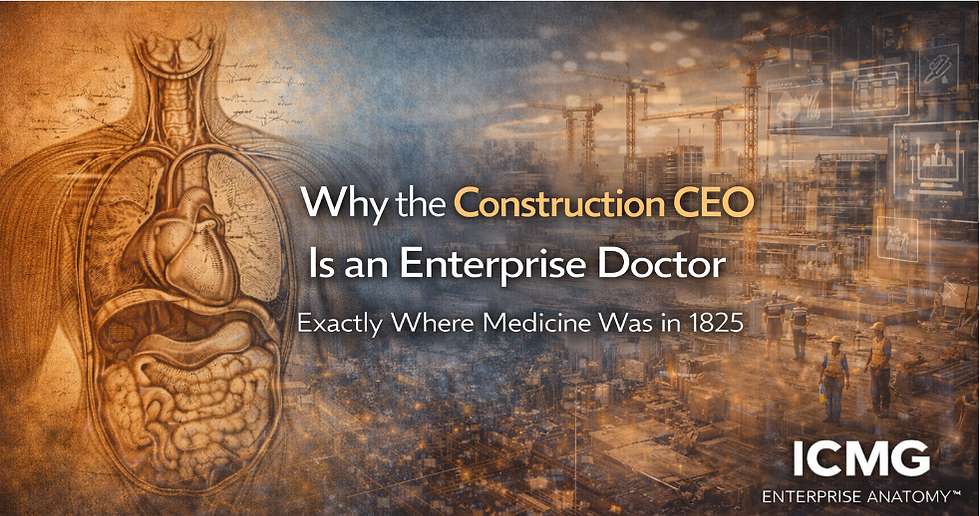
Why the Construction CEO Is an Enterprise Doctor — Exactly Where Medicine Was in 1825
- Sunil Dutt Jha

- Apr 2
- 4 min read
This article is not about cranes, concrete, or project schedules. It is about how Construction CEOs are forced to operate today — and why that role increasingly feels reactive, exposed, and exhausting despite experience, controls, and hard-won lessons.
Every day, the Construction CEO listens to symptoms.
Projects that look healthy until the final quarters.
Claims that surface late and escalate fast.
Schedules that drift despite detailed planning.
Safety incidents that recur across sites.
Cash flow surprises that arrive after progress is reported.
Problems that appear “managed” — only to reappear in another project.
The CEO reviews tests.
Project dashboards.
Cost and margin reports.
Claims registers.
Safety and quality summaries.
Portfolio reviews.
And then the CEO is expected to diagnose what is really wrong — and prescribe interventions without stopping live projects, breaking contracts, or escalating disputes.
This places today’s Construction CEOs exactly where medical doctors stood in 1825.
Medicine Before Anatomy: The World of 1825
In 1825, medicine was practiced by capable, committed doctors.
They observed symptoms carefully.
They documented cases.
They refined tools.
They relied on judgment and experience.
What they lacked was not discipline or care. They lacked formal anatomy. Human bodies were externally familiar but internally opaque. Diagnosis depended on observation and memory. Treatment varied depending on the doctor. Outcomes were inconsistent. Knowledge did not survive people leaving.
Medicine worked — but only as long as the right doctor was present. This was not bad medicine. It was pre-anatomy medicine.
Where the Construction CEO Stands Today
Modern construction enterprises appear far more structured than medicine did in 1825.
Projects are planned.
Contracts are detailed.
Controls exist.
Audits are routine.
Yet execution behaves in a familiar way. Local site decisions undermine portfolio outcomes. Workarounds keep schedules moving temporarily. Knowledge concentrates in a few project leaders. Escalations reach the CEO during disputes or crises.
This happens for the same reason medicine once struggled. Construction enterprises operate without an explicit, shared enterprise anatomy.
So Construction CEOs practice enterprise medicine using experience, memory, intuition, and escalation.
Why the CEO’s Office Runs on Experience — Until It Breaks
In many construction organizations, execution does not truly run on structure. It runs on experience.
Who knows how to “manage” a difficult subcontractor.
Which workaround keeps progress claims flowing.
Which compromise avoids disputes — for now.
Which site leader can “fix it” when plans fail.
This works — temporarily. As long as key individuals remain, delivery appears controlled. When they rotate, leave, or scale increases, familiar symptoms return:
claims rise,
productivity varies,
safety risk increases, and
the CEO becomes the final integration point again.
This is not leadership failure. It is enterprise medicine without anatomy.
The Construction Enterprise Has Organs — Even If They Are Not Visible
A construction enterprise is a living organism. Its organs include bid management, design coordination, planning, procurement, subcontractors, site execution, safety, quality, claims, finance, compliance, technology platforms, and portfolio governance.
Each of these organs already operates across the same internal layers:intent, process, decision logic, systems, change activity, and daily operations.
This anatomy already exists. But when it is not explicit and shared, each project interprets it independently.
The CEO becomes the point where contradictions surface — acting as nervous system, circulatory system, and immune response at the same time. That is not scalable medicine.
Why Interventions Create Side Effects in Construction
Before anatomy, doctors treated symptoms directly.
Sometimes patients improved.
Sometimes new complications appeared.
Often the underlying condition remained.
The same pattern appears in construction.
A schedule recovery increases cost and safety risk.
A claims settlement damages relationships elsewhere.
A productivity push compromises quality.
A system rollout increases reliance on a few experts.
These are not bad decisions. They are interventions applied without full anatomical visibility.
What Changes Once Anatomy Becomes Visible
When medicine gained anatomy, doctors did not become less experienced. They became precise.
Diagnosis replaced intuition.
Treatment targeted causes, not symptoms.
Knowledge survived individuals.
Outcomes became repeatable.
The same shift occurs when construction enterprise anatomy becomes explicit.
The CEO no longer relies on experience alone to diagnose.
Portfolio risk reduces structurally, not heroically.
Interventions become targeted instead of disruptive.
Scale increases control rather than exposure.
Enterprise medicine becomes possible.
Why This Perspective Matters for Construction CEOs
This article is not intended to explain Enterprise Architecture. It exists to explain why Construction CEOs feel the pressure they do, even when projects are controlled and teams are experienced.
The repetition.
The disputes.
The late surprises.
The sense that scale increases risk instead of stability.
These are signals. They are the same signals medicine experienced before anatomy transformed the discipline.
The Choice Facing Construction CEOs
In 1825, medicine faced a choice:continue relying on experience and memory, or formalize anatomy and change permanently. Construction enterprises face the same choice today.
Execution can continue to depend on project heroics, contracts, and escalation. Or it can be governed through an explicit enterprise anatomy that allows CEOs to diagnose conditions and intervene safely.
If you are evaluating why Enterprise Architecture must sit with the Construction CEO, begin with: Why Does the Construction CEO Need Enterprise Architecture?
This article exists to explain why that question keeps returning — and why it will not go away.