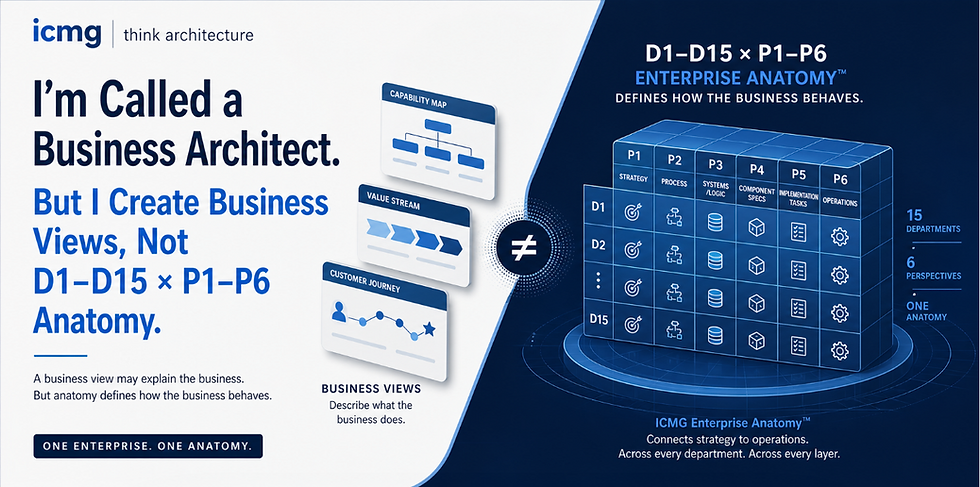
I’m Called a Business Architect. But I Mostly Create Capability Maps for IT Programs.


The Map Looks Strategic
I’m called a Business Architect.
One of my main outputs is a capability map.
The map looks powerful. It shows what the business is capable of doing. It groups business functions into neat layers. It gives leadership a clean view of the enterprise. It helps IT understand which systems support which capabilities.
This is useful work.
But a capability map is not automatically architecture. A capability map names what the business can do. It does not automatically define how the business behaves.
That is the difference.
Where the Distortion Begins
The distortion begins when a capability map created for an IT program is treated as Business Architecture.
The map may show:
customer management, revenue management, operations management, asset management, workforce management, finance management, risk and compliance, data and technology.
It looks enterprise-wide.
But in many cases, the map is used mainly to support IT decisions:
which systems overlap, which applications support which capability, which platforms need modernization, which tools should be rationalized, which projects should be prioritized.
That helps the CIO. But it does not automatically define the business anatomy.
The Airline Context
Want to read more?
Subscribe to architecturerating.com to keep reading this exclusive post.